Issue #123

Intended for teachers of diplomacy and related courses, here is an update on resources that may be of general interest. Suggestions for future updates are welcome.

Bruce Gregory can be reached at BGregory@gwu.edu  

Bruce Gregory, American Diplomacy’s Public Dimension: Practitioners as Change Agents in Foreign Relations, (Palgrave Macmillan, 2024). 

Get the eBook text and paperback here.    

Get Kindle and paperback here.

Matthew Asada, “The Department of State’s Reception Centers: Back to the Future,”  The Foreign Service Journal, April 2024, 38-42. State Department Foreign Service Officer Asada is a visiting senior fellow at USC’s Center on Public Diplomacy where he has written a carefully researched history with interesting photos of the Department’s 20th century US-based reception centers (Seattle, San Francisco, Honolulu, New Orleans, Miami, Washington, DC, and New York). All but the New York center were closed decades ago due to budget cuts. Their responsibilities were absorbed by local organizations, many affiliated with the National Council for International Visitors (now Global Ties, U.S.). Asada frames the narrative as a predicate for ways to enhance State’s domestic engagement today. Among his ideas: establish domestic geographic districts (aligned with federal regions and divisions); establish “Diplomatic Engagement Centers” in districts or spanning districts; and bring together existing offices concerned with exchange programs, public outreach, media engagement, public-private partnerships, liaison with city and state officials, and support for foreign embassies and consulates.

Niklas Bremburg and Anna Michalski, “The European Union Climate Diplomacy: Evolving Practices in a Changing Geopolitical Context,”  The Hague Journal of Diplomacy, online publication, April 12, 2024. Bremburg (Stockholm University) and Michalski (Uppsala University) examine the evolution of the EU’s climate diplomacy following the “perceived failure” of COP15 in Copenhagen in 2009 and the consequences of rising geopolitics for the global climate agenda. They use practice theory methods in IR and diplomacy studies to show how the EU’s External Action Service and member states adopted a more “linked-up and universal approach” to its climate mitigation and adaptation diplomacy. Using a combination of elite interviews and systematic analysis of official documents and academic literature they assess the EU’s adoption of four practices. (1) Creation of narratives to persuade other actors to strengthen their global climate agendas. (2) Efforts to co-ordinate the negotiating positions and objectives of EU and member states. (3) Outreach actions tailored to the interests of selected national governments, businesses, and civil society organizations. And (4) the practice of mainstreaming, meaning dealing with climate change in the context of human rights, migration, trade, geopolitics, and other issues. Bremburg and Michalski conclude that, despite these operational practices, deep-seated beliefs by EU diplomats and officials “have remained more or less unchanged,” particularly their reliance on leading in climate negotiations through the power of example. They also call for more context-specific analysis and evidence to support answers to why, how, and with what effects diplomatic practices shape policy outcomes. 

Andrew F. Cooper, The Concertation Impulse in World Politics: Contestation Over Fundamental Institutions and the Constrictions of Institutionalist International Relations, (Oxford University Press, 2024). Cooper’s (University of Waterloo) prodigious body of work ranges from deep dives into IR theory and global governance to studies of diplomatic practice, notably in the BRICs, G-7, and G20. His writings include Celebrity Diplomacy (2008), “Adapting Public Diplomacy to the Populist Challenge,” (The Hague Journal of Diplomacy, 2019), and other articles on practitioners in diplomacy’s public dimension. Cooper’s new bookcombines a rereading of Hedley Bull’s understudied ideas about the concept and practice of concertation in world politics with a multi-faceted critique of mainstream IR. The latter includes neglect of crises as stimulants of international change, a stereotyped “non-West” as either subordinate to universalistic “rules of the game” or potential disrupters of the system, and inattention to the disruptive effect of domestic forces in the United States (Donald Trump’s personalist-populist challenge). Cooper defines concertation as “an institutional format that places the emphasis on forms of dialogue, mutual exchange of information, knowledge sharing, and the aim of unified proposals, among competing and even fractious actors.” His book explores how the institutional concert format – understood as the construction of patterned practices used to solve problems and facilitate co-existence – is a productive approach to sovereignty and multilateralism. Analytical chapters address Bull’s scholarship and institutional IR as a foil for his book. Other chapters discuss concertation as a foundational and sustained fundamental institution, the G-20 as a modern institutional concertation format, the challenges of personal-populist disruption, and aspirations of the BRICs as a solidarity concert and plurilateral summitry.

“Disinformation is on the Rise. How Does it Work?”  The Economist, May 4, 2024, 66-71. The Economist devotes its entire Science & Technology section in this issue to a discussion of what disinformation is, how it works, and how it can be mitigated. The feature article explores the role of AI in creating disinformation, detecting it, and using it to overcome problems it creates. Issues discussed include the uses of analytical tools in combination and challenges of distinguishing between disinformation originators and spreaders. The article includes a case study of the disinformation campaign intended to falsely show that Ukraine’s first lady Olena Zalenska spent $1.1m of Ukrainian aid on jewelry. It summarizes the role of the US State Department’s Global Engagement Center in exposing and responding to a Russian campaign to discredit Western health programs in Africa. The article also takes aim at how US efforts to fight disinformation through coordinated activities of tech companies, academics, government agencies, civil society groups, and media organizations have become entangled in polarized politics and the objects of litigation and right-wing conspiracy theories. The experiences of Taiwan, Finland, Sweden, and Brazil are also examined. Separately, in an editorial, “Truth or Lies?” (p. 10), The Economist optimistically states that although disinformation is a serious problem there is little evidence it alone can influence election outcomes, and “it has not yet revealed itself as an unprecedented and unassailable threat.”

David V. Gioe and Michael J. Morell, “Spy and Tell: The Promise and Peril of Disclosing Intelligence for Strategic Advantage,”  Foreign Affairs, May/June 2024. CIA director Bill Burns calls it “intelligence diplomacy.” Gioe (Kings College London) and Morell (Beacon Global Strategies), both former CIA practitioners, call it “strategic disclosures.” It is a strategy with a long history in diplomacy’s public dimension: U-2 spy plane disclosures of Soviet missile bases in Cuba, Colin Powell’s satellite images of alleged weapons sites in Iraq, and recent advance disclosures of Russia’s plans to invade Ukraine. In their measured assessment, Gioe and Morell assess differences between recent vetted disclosures of secrets that serve public interests, seen as resoundingly successful, and leaks that serve private interests. They conclude with a call for caution and guardrails. Disclosures must protect sources and methods. Revelations that are wrong damage reputations and undermine goals. They are especially concerned that using intelligence as a policy and diplomacy tool risks it being used as a partisan political weapon. Gioe and Morell emphasize that in today’s disinformation environment the disclosed information must be true. “Although it may be tempting to embed disinformation in a disclosure, that line should never be crossed.”

Alan K. Henrikson, “What is Public Diplomacy? Fostering Cooperation, Countering Disinformation,”  Baku Dialogues: Policy, Perspectives on the Silk Road Region, Vol. 7, No. 2 (Winter 2023-2024), 98-117. In this article Henrikson (Professor of Diplomatic History Emeritus and founding Director of Diplomatic Studies at The Fletcher School of Law and Diplomacy) has adapted and made more accessible an essay he published as chapter 11 in “The Role of Diplomacy in the Modern World,” in Reimagining the International Legal Order​, ed. Vesselin Popovski and Ankit Malhotra (Routledge, 2024),145-168. These essays address the international legal framework in which public diplomacy is and should be conducted. He frames his analysis in a discussion of five interrelated steps: (1) the origins and “historically evolved” meaning of the term public diplomacy, (2) the range of public diplomacy activities and how they can vary with country size, (3) his central legal-normative question, (4) challenges to public diplomacy in the international political system and global communications space, and (5) a critique of responses to these challenges and suggestions of ways public diplomacy could strengthen the international legal order and contribute to global comity and human enlightenment. Henrikson’s essays stand out in the vast literature on public diplomacy for their assessment of understudied legal and normative issues, and ways in which narrative and power are related. 

Jovan Kurbalija, History of Diplomacy and Technology: From Smoke Signals to Artificial Intelligence, (DiploFoundation, 2023). In this slim, well-resourced, and easy to read volume, DiploFoundation’s executive director examines the ways changing technologies interact with the continuity of diplomacy in human experience. He shapes the narrative in three contexts. The impact of technologies on power distribution, geopolitics, and the relevance of countries, cities, and continents. The topics and issues that diplomats address. And the tools diplomats use to communicate, negotiate, and build relationships. Images, graphics, and affordable pricing make this an excellent book for courses in diplomacy and global communications.

“Letters-Plus,” The Foreign Service Journal, April 2024, 13-15. In FSJ’s April issue, three seasoned career diplomats respond to the Journal’s March 2024 article, “A Look at the New Learning Policy: How, When, and Where Do State Department Employees Learn,” by Sarah Wardwell. In “A Step in the Right Direction,” retired FSO Alexis Ludwig welcomes State’s intentions but rightly contends that success will depend on harnessing the political will to make implementation mandatory and obtaining the resources needed to achieve results at scale. In “Prioritizing Learning,” acting deputy assistant secretary for passport services Don Jacobson applauds this “potentially transformative commitment to professional development.” Much will depend, he observes, on the time commitments and strategic thinking of supervisors at all levels and the need for all employees to take ownership of their professional development. Career Ambassador James Jeffries in “Deeply Disillusioning” objects that with one exception none of the policy’s 16 Core Curriculum courses seem to address State’s central foreign policy mission.

Keith E. Peterson, American Dreams: The Story of the Cyprus Fulbright Commission, (Armida Publications, 2024). Peterson’s career as a US diplomat included information officer, cultural officer, and PAO assignments in Dhaka, Tunis, Nicosia, Bridgetown, London, Valetta, Stockholm, and Washington. American Dreams is his account of the 52-year history of the independent bicommunal Fulbright Commission in Cyprus, its role in bridging different memories and visions of Greek and Turkish Cypriots, the difficulties it encountered in conflict resolution training, and the commitment of its Greek, Turkish, and American board members. His book is both a narrative of strategic issues and the Cold War politics of Cyprus and a useful case study of one Fulbright Commission facing unusually difficult operational challenges.

Peter Pomerantsev, How to Win the Information War: The Propagandist Who Outwitted Hitler,  (PublicAffairs, 2024). In his latest book, Pomerantsev (Johns Hopkins University), author of Nothing Is True But Everything Is Possible (2015) and This Is Not Propaganda (2020), combines analysis of Russian disinformation under Vladimir Putin with a biography of the British print and broadcast journalist Thomas Sefton Delmer. Through his parties for top Nazi officials and flattering articles, Delmer gained access and scoops. When war began in 1939, he was recruited by British intelligence. Pomerantsev’s book is part history, part biography, and part guide to understanding and countering disinformation. It has garnered praise from Timothy Snyder, author of On Tyranny (2017), The Atlantic’s Anne Appelbaum, and The Financial Times’ Gideon Rachman. For a critical review, see Max Fisher, “The Journalist Who Tried to Fight the Nazis With Radio Stories” The New York Times, March 9, 2024. 

David E. Sanger, New Cold Wars: China’s Rise, Russia’s Invasion, and America’s Struggle to Defend the West, (Crown, 2024). Twenty-five years ago, the New York Times’ David Sanger and the Washington Post’s Dana Priest, then rising national security reporters, were quick to accept cold call invites to meet with US and international students in small (14 person) seminars at the National War College. They valued professional education, but they also knew they were connecting with future ambassadors and flag rank military officers. The range and depth of the interviews in Sanger’s latest book demonstrate the wisdom of this reportorial strategy. It is a deeply connected reporter’s easy to read account of “the revival of superpower conflict” and struggles for military, economic, political, and technological supremacy. He examines not only how leaders and key aides assessed strategic choices but also how they sought to frame their choices in the public square. Three cameos are particularly useful. Sanger’s analysis of NSC advisor Jake Sullivan’s reasoning and desire to shape the “information narrative” as to what was happening and who was responsible for Russia’s invasion of Ukraine in advance (pp. 210-215). His discussion of how the toxic zero sum domestic debate on US immigration policies damages US soft power and creates many missed opportunities including attracting a younger generation of Russians to emigrate (pp. 447-449). And his Epilogue in which the reporter turns opinion writer on what’s new in the new cold wars and what the future may hold.

Elizabeth N. Saunders, The Insiders’ Game: How Elites Make War and Peace, (Princeton University Press, 2024). Saunders (Columbia University) begins with a paradox. Publics have scarce time for the details of most foreign policies and issues. Yet leaders act as if public opinion matters, even though they rarely change public views and attitudes through persuasion. Why then, she asks, do elites care about public opinion? Her book provides explanations for this paradox and a thoughtful examination of the importance of political elites in democratic governance and decision-making. Elites lead mass opinion in part, she argues, because publics use trusted elite cues as shortcuts. Saunders distinguishes between leaders and three groups of elites with systematic influence: lawmakers, military leaders, and senior government officials. Grounded in survey experiments and case studies, her book is a nuanced assessment of how elites shape choices in war and peace decisions in the United States — with frequent asides for her theory’s implications for other democracies. This is a study of elite politics, decision-making as an “insider’s game,” a “hawkish bias” in a militarily powerful country, elite accountability, and how a democracy initiates, escalates, and ends wars. It combines well written and interesting history with sophisticated theoretical analysis. 

Sarah E. K. Smith and Sascha Priewe, eds., Museum Diplomacy: How Cultural Institutions Shape Global Engagement, (American Alliance of Museums, 2023). Smith (Western University, Ontario) and Priewe (Aga Khan Museum, Toronto) have compiled 18 chapters by practitioners and scholars on the global engagement of museums. Contributors address a range of professional, cultural, political, and academic issues. The editors situate their contributions in a conceptual framework that treats museum diplomacy as a subset of cultural diplomacy now carried out by state actors, cities and other substate actors, and a diverse array of nonstate actors. Museums exist to educate and provide enjoyment. They also serve political agendas as “arbiters of cultural significance, custodians of prized objects, and narrators of histories, communities, and identities.” Chapters address ways museums have advanced hegemony and current efforts to achieve decolonization and social justice. The collection, which includes case studies, contributes helpfully to current debates over cultural diplomacy, network diplomacy, cross cultural globalism, and boundaries between what is and is not diplomacy.

Elise Stephenson and Susan Harris Rimmer, “Bolstering the Boys Club: Security Vetting, Diversity and Diplomatic Gatekeeping,”  The Hague Journal of Diplomacy, online publication, May 8, 2024. Stephenson (Australian National University Canberra) and Rimmer (Griffith University) turn the focus on gender and diplomacy away from serving diplomacy practitioners to the security clearance processes that influence levels of clearance and career progression. They argue that clearance processes include not only criteria use to assess potential national security risks but also values (loyalty, maturity, trustworthiness), which may lead to bias or discriminatory exclusion. Their research is grounded in a larger Australian project that also focuses on cultural and linguistic diversity, First Nations and Indigenous inclusion, generational differences, sexuality, neurodiversity, mental health, and people living with disabilities. The authors discuss a variety of issues related to security vetting processes and methodological challenges for researchers. They conclude that problematic security clearance processes mean the exclusion of women and sexual minorities remains “explicit policy and practice.”

US Advisory Commission on Public Diplomacy, “Celebrating 75 Years of ACPD Reporting: ACPD Official Meeting Minutes,” February 26, 2024, Transcript here and Video hereThe Commission’s meeting, held at George Washington University’s Elliott School of International Affairs and moderated by Executive Director Vivian Walker, achieved two goals. First, the Commission presented its Comprehensive Annual Report on Public Diplomacy and International Broadcasting: Focus on FY 2022 Budget DataThe report provides detailed budget and program data on the public diplomacy activities of the US Department State and activities of the US Agency for Global Media. Critically important are the Commission’s 25 policy, program, and structural recommendations to the White House, Congress, State Department, and USAGM at pp.13-16. Second, Commissioners and a panel reflected on the presidentially appointed, bipartisan Commission’s essential and durable role in US public diplomacy for 75 years. Panelists included: Tom C. Korologos, ACPD Commissioner and Chairman, 1981-1994, former Ambassador to Belgium, and founding member of the Broadcasting Board of Governors; Katherine Brown, President and CEO of Global Ties U.S. and APCD Executive Director, 2013-2016; and Bruce Gregory, Visiting Scholar, George Washington University and ACPD Executive Director, 1985-1998. 

US Advisory Commission on Public Diplomacy, “The Global Engagement Center: A Historical Overview 2001-2021,” May 2024. In this timely, important, and deeply researched 47-page report, the Commission’s senior advisor Adele E. Ruppe and executive director Vivian S. Walker examine the origins, evolution, mandates, objectives, tools, methods, and activities of the US State Department’s Global Engagement Center (GEC). The GEC’s mission is to counter foreign state and non-state disinformation threats to US national security. The report is grounded in interviews with 22 former and current political appointees and senior officials, legislative and archival records, and the insights of the Commission’s professional staff. Following a detailed historical overview, illuminated by helpful graphics, the report identifies a series of findings and lessons learned. Findings include the importance of Senate confirmed under secretaries of state for public diplomacy and public affairs, the need for White House validation and strong bipartisan support, and alignment of expectations and activities with budget realities. Other findings point to the disruptive impact of changes in administrations and funding delays due to cumbersome authorization processes and bureaucracies in the State and Defense Departments. 

Looking ahead, the Commission identified eight lessons learned: (1) the United States needs a GEC located within State to counter global disinformation threats; (2) the GEC requires appropriate legislative and executive branch legal authorities; (3) adequate support from interagency stakeholders is essential; (4) the Defense Department and intelligence community are crucial partners; (5) direct funding is required rather than highly inefficient indirect funding through other government entities; (6) special authorities and hiring mechanisms are necessary to recruit specialized expertise; (7) flexible capabilities and funding are key to coping with constant change in the threat environment; and (8) mistaken past assumptions that disinformation threats can be “eliminated” means a robust and sustained GEC or similar entity is necessary to counter a radically new global disinformation environment. 

The Commission’s bipartisan report provides essential knowledge and advice in the context of partisan attacks from critics in Congress and elsewhere (e.g., Elon Musk, The Federalist, the Daily Wire, and the state of Texas). See “Don’t Defund the Fight Against Russia and China’s Disinformation,” Editorial, The Washington Post, March 19, 2024 and Steven Lee Meyers, “State Department’s Fight Against Disinformation Comes Under Attack,” The New York Times, December 14, 2023. 

US Department of State, “United States International Cyberspace & Digital Policy Strategy,”  May 2024. The State Department’s strategy, framed as a policy of “digital solidarity,” sets forth goals for achieving effective uses of technologies in diplomacy by the US and its allies and partners; an open, inclusive, secure, and resilient internet; and responsible behavior by political entities in cyberspace. The document states that a US goal also is to maintain global technology primacy and set global standards and norms. Part one of the document examines threats to national security and internet freedom, protection of physical infrastructures, competing internet norms, challenges to digital economies, the future of AI technologies governance, and working with the private sector and civil society. Part two sets forth priorities and examines four “action domains” to achieve policy goals. The Department’s Ambassador at Large for Cyberspace and Digital Policy Nathaniel Fick summarized its importance in an interview with The New York Times, “Just about everyone is willing to acknowledge that technology is an important element of foreign policy, but I would argue that tech is not just part of the game — it’s increasingly the entire game.” The “entire” game is debatable. Technologies are tools of diplomacy and policies. As with most strategy documents, much will depend on how road maps are implemented, how cost/benefit choices are made, and how bureaucratic wars are fought and won. See also, David Sanger, “A New Diplomatic Strategy Emerges as Artificial Intelligence Grows,”  May 6, 2024, The New York Times;  Rishi Iyengar, “Washington Takes Its Cyber Strategy Global,”  May 8, 2024, Foreign Policy; Office of the National Cyber Director, “2024 Report on the Cybersecurity Posture of the United States,” May 2024; and report Fact Sheet.

Recent Items of Interest

Madison Alder, “State Department to Use New Purdue Tech Diplomacy Platform to Train Officials,”  April 30, 2024, Fedscoop.

Anne Applebaum, “The New Propaganda War,”  May 6, 2024, The Atlantic.

Phillip C. Arceneaux, “‘Nation of Storytellers”: Ireland’s Public Diplomacy Success Centers on Storytelling,”  March 22, 2024, CPD Blog, USC Center on Public Diplomacy.

Matt Armstrong, “Main Street on a Flattop aka Operation Flattop,”  May 6, 2024; “Political Warfare: The Obvious Choice Against Our Maginot Line,”  April 19, 2024; “It’s Not New, We’re Just Ignorant,”  April 4, 2024, Arming for the War We’re In.

Michael Birnbaum, “U.S. Diplomat Explains Why She Quit Biden Administration Over Gaza War,”  April 30,2024, The Washington Post.

Antony J. Blinken, “Building a More Resilient Information Environment,”  March 18, 2024, US Department of State.

Doug Cunningham, “State Department Invites 22 Countries for Some Hip-hop Diplomacy,”  April 17, 2024, UPI. 

“Don’t Defund the Fight Against Russia and China’s Disinformation,”  March 19, 2024, Editorial Board, The Washington Post.

Andrew Dubbins, “Public Diplomacy in the News: Michael Douglas as Ben Franklin, Global Health, and Election Misinformation,”  April 22, 2024, CPD Blog, USC Center on Public Diplomacy. 

Jorge Heine, “Attacks on Embassies in Ecuador and Syria Set a Dangerous Precedent,”   April 23, 2024, The Washington Diplomat; “Are Embassies Off-limits? Ecuadorian and Israeli Actions Suggest Otherwise — And That Sets a Dangerous Diplomatic Precedent,”  April 9, 2024, The Conversation.

Ellice Huang, “Can You Change Your Mind? Decision-making and the Debate on AI Regulation,”  April 17, 2024, guest post, fp21.

Zhao Alexandre Huang, “China’s Digital Public Diplomacy Towards ASEAN Countries: How Beijing Frames the South China Sea Issue,”  May 6, 2024, CPD Blog, USC Center on Public Diplomacy.

Patricia H. Kushlis, “Santa Fe Forum Reviews US Place in the World,”  May 2024,  Public Diplomacy Council of America.  

Don Jacobson, “Speaking Out: It’s Up To Us to Implement the Learning Policy,”  May 2024, The Foreign Service Journal.

Umme Laila, “Chinese Soft Power and Public Diplomacy in the United States,”  May 15, 2024, CPD Blog, USC Center on Public Diplomacy.

Joseph I. Lieberman and Gordon J. Humphrey, “How to Start Winning the Information War,”  April 2, 2024, The Washington Post.

Ilan Manor, “From ‘Wolf Warrior Diplomacy’ To ‘Lone Wolf Diplomacy,’ The New Logic of Digital Diplomacy,”  May 15, 2024, CPD Blog, USC Center on Public Diplomacy.

“Meet the Author: Bruce Gregory on ‘American Diplomacy’s Public Dimension,”  April 22, 2024, USC Center on Public Diplomacy.

Sherry Mueller, “Citizen Diplomacy — The Role of the Individual in Foreign Affairs,”  April 2024;  “International Visitor Leadership Program,”  April 2024; “Senator Fulbright’s Letter To President Reagan On The Importance Of Exchange Programs To U.S. National Security,”  March 2024, Public Diplomacy Council of America. Letter available here.

John K. Naland, “AFSA and the Evolution of the Foreign Service Career,”  May 2024, The Foreign Service Journal.

Caroline Nihill, “State Department is Launching an Internal Chatbot,”  April 2, 2024, Fedscoop.

David Pierson, “U.S.-Funded Broadcaster [Radio Free Asia] Leaves Hong Kong, Citing Security Law,”  March 29, The New York Times.

Katie Robertson, “Voice of America Will Get a New Director,”  April 19, 2024, The New York Times.

Jon Schaffer, “Youth Exchanges: ‘The Perfect Fit’ For This Volunteer,”  May 2024, Public Diplomacy Council of America.

Alexander Smith, “Antony Blinken’s Guitar Diplomacy Draws Criticism in Ukraine,”  May 15, 2024, NBC News.

Tara D. Sonenshine, “How Russia and China are Ridiculing America,”  April 9, 2024; “A Triple Threat in the Middle East: Hamas, Hezbollah, and the Houthis,”  March 21, 2024, The Hill.

Dan Spokojny, “Should Artificial Intelligence Be Used in Foreign Policy?”  May 7, 2024; “Should I Distrust Story Telling?”  May 1, 2024; “A Roadmap to Modernize Foreign Policy,”  April 11, 2024; “Foreign Policy Expertise Requires a Culture of Evidence,”  April 2, 2024; “The World is Hard to Change,”  March 29, 2024; “Foreign Policy Doesn’t Promote Expertise: But It Could,”  March 20, 2024, fp21substack.

Jillian Steinhauer, “For U.S. Pavilion At Venice Biennale, a Bold Rainbow,”  April 14, 2024Julia Halperin, “Indigenous Artists Are the Heart of This Year’s Venice Biennale,”  April 14, 2024, The New York Times.

Bill Wanlund, “Worried About Disinformation? Chill [Thoughtfully],”  April 2024, Public Diplomacy Council of America.  

Gem from the Past

Taylor Owen, Disruptive Power: The Crisis of the State in the Digital Age, (Oxford University Press, 2015). Almost a decade ago, Taylor Owen (McGill University) took the measure of ways in which digital technologies were transforming states and key institutions underpinning world order. Luminaries who endorsed his book included Anne-Marie Slaughter, Michael Ignatieff, Clay Shirkey, and Joseph S. Nye, Jr. Although technologies and the global environment have changed greatly in subsequent years, his central arguments in this slim volume are worth another look. Owen rehearses now familiar themes: the decentralization of hierarchical power, the rise of individuals and groups empowered by digital technologies, and the challenges states face in giving up power to achieve success in a networked world. Today, when much of the literature prioritizes technologies over diplomacy and governance, Owen puts power, accountability, stability, and democratic engagement first and technologies second. His final three chapters constitute a prescient examination of public diplomacy’s uses of social media, how the “violence of algorithms” is blurring boundaries in war and international relations, and models for the structural adaptation of traditional institutions.

An archive of Diplomacy’s  Public Dimension: Books, Articles, Websites  (2002-present) is maintained at George Washington University’s Institute for Public Diplomacy and Global Communication.  Current issues are also posted by the University of Southern California’s Center on Public Diplomacy, and the Public Diplomacy Council of America.

The Digital Double Bind: Change and Stasis in the Middle East

By Yvonne Oh, IPDGC Program Coordinator

In his latest book, IPDGC Visiting Scholar Joe F. Khalil explores the interplay of digital technology and socio-political shifts, providing valuable perspectives on the evolving landscape of the Middle East. His presentation of “The Digital Bind: Change and Stasis in the Middle East,” co-authored with Mohamed Zayan.

Khalil explores how the Middle East’s digital turn intersects with complex political, economic, and socio-cultural dynamics. Drawing on local research and rich case studies, they show how the same forces that brought promises of change through digital transformation have also engendered tensions and contradictions. With this book, Khalil and his co-author contend that the ensuing disjunctures have ensnared the region in a double bind, which represents the salient feature of an unfolding digital turn. The same conditions that drive the state, market, and public immersion in the digital also inhibit the region’s drive to change.

Publishing house Oxford Press describes The Digital Double Bind as a book that reconsiders the question of technology and change, moving beyond binary formulations and familiar trajectories of the network society. It offers a path-breaking analysis of change and stasis in the Middle East and provides a roadmap for a critical engagement with digitality in the Global South.

Listen to the podcast on PDx.

A warm welcome to our Visiting Scholar from New Zealand

By Yvonne Oh, IPDGC Program Coordinator

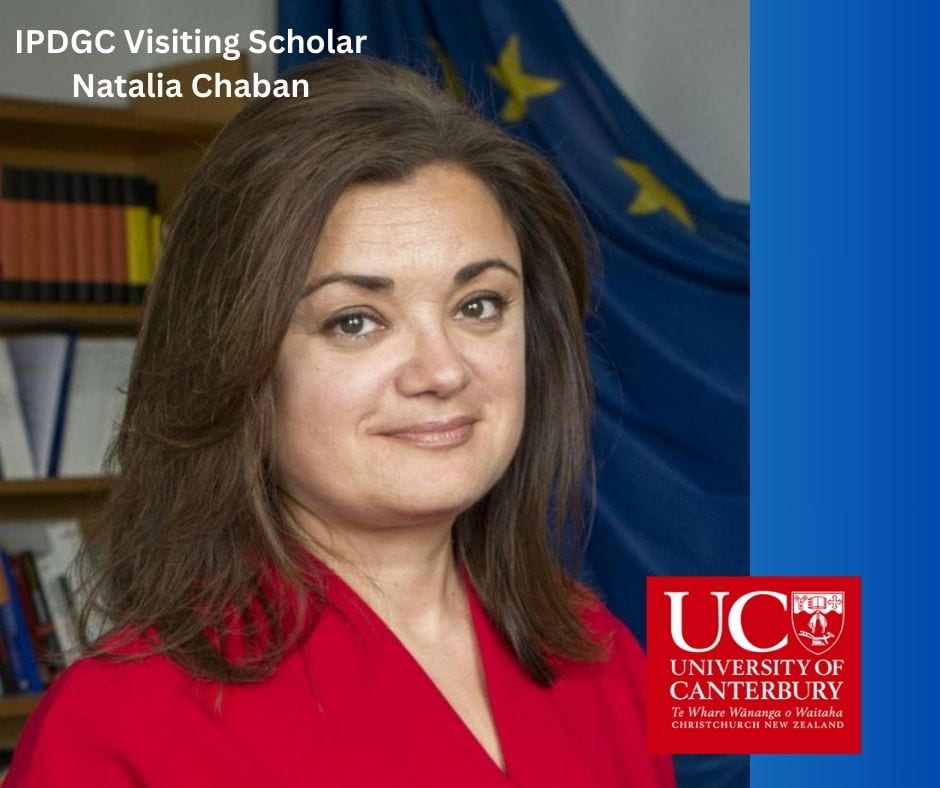
IPDGC welcomes Professor Natalia Chaban, professor in the Department of Media and Communication at the University of Canterbury in New Zealand. Professor Chaban is a leading expert in image and perceptions studies within the EU and IR contexts, and in public diplomacy and political communication.

As a Visiting Scholar with our Institute, she will be researching “Public diplomacy at times of conflict and crises”, which will allow her to apply and extend her expertise in image and perceptions studies, international political communication and media ecology studies, while considering the three cases informed by her original theorization of the perceptual approach to foreign policy studies.

Professor Chaban has led multiple transnational research projects externally supported by the Erasmus+ of the European Commission, Foreign Policy Instrument Division of the European Commission/European External Action Service, EU member states’ embassies and NATO.

She is also widely published in high impact foreign policy journals such as Journal of Common Market Studies, Cooperation and Conflict, Journal of European Integration and Foreign Policy Analysis.

Our Institute and the wider GW scholarly community look forward to collaborating with Professor Chaban on this very topical and timely research.

Congratulations to Matt Snow, recipient of 2024 Walter Roberts Public Diplomacy Studies award.

By Yvonne Oh, IPDGC Program Coordinator

Since 2011, the Walter Roberts Endowment and the Institute for Public Diplomacy and Global Communication (IPDGC) has spent time learning how our GW graduate students plan their future global careers, and with this year’s award we recognize one exceptional student who has shown exemplary performance in public diplomacy studies.

Matthew Snow, a graduate student at GWU’s Elliott School and the MA in Global Communication program, has been selected as the recipient of the Walter Roberts Award for Public Diplomacy Studies. This award recognizes Matthew’s exceptional academic performance and current work related to public diplomacy, as well as his aspirations to continue contributing to the field.

Matt’s time in the graduate program saw him refine his skills, competencies, and knowledge to launch him into a career as a U.S. diplomat. His studies were a vehicle of personal and professional growth.

I was drawn to public diplomacy by the parallels from my time in the music industry. Being on tour in a band means constantly creating new connections, forging new relationships, and hopefully making new fans. It is also a lot of hard work to find ways of connecting with people you’ve never met in places you’ve never been.

Matthew Snow, MA Global Communication ’24

His professors have been impressed with his eagerness for positive engagement. GW adjunct professor Dr. Patricia Kabra, a Senior Officer in the Foreign Service, noted that Matt always demonstrated openness and support for fellow students, shared his knowledge, and encouraged classmates to think creatively about public diplomacy.

This award is a testament to Matt’s dedication, passion, and ability to engage with others. His future in public diplomacy is bright, and we look forward to seeing the positive impact he will undoubtedly make in the field.

Congratulations Matt, on this well-deserved honor!

Issue #122

Intended for teachers of diplomacy and related courses, here is an update on resources that may be of general interest. Suggestions for future updates are welcome.

Bruce Gregory can be reached at BGregory@gwu.edu  

Bruce Gregory, American Diplomacy’s Public Dimension: Practitioners as Change Agents in Foreign Relations, (Palgrave Macmillan, 2024). 

Get the eBook text and paperback here.    

Get Kindle and paperback here.

Phillip Arceneaux, “Value Creation Through Organizational Storytelling: Strategic Narratives in Foreign Government Relations,”  Public Relations Review, Vol. 50, Issue 2, June 2024. Arceneaux (Miami University of Ohio) examines ways in which governments use public relations and tell stories to promote their interests and create value in competitive environments. He begins with a brief literature review followed by discussion of conceptual issues in narrative theory, the politics of strategic narratives, and use of value propositions to build brands and convey value through stories. He grounds his analysis in a comparison of Canadian, Irish, and Norwegian campaigns to win a seat on the UN Security Council. Arceneaux argues practitioners need to adopt a storytelling approach that blends identity, system, and issue narratives with a holistic content strategy. His conclusion: “Contextualizing strategic narratives as value propositions expands the interdisciplinarity of government public relations scholarship at the nexus of international relations, public diplomacy, and nation branding.” The article is available for a limited time through open access.

André Barrinha, “Cyber-diplomacy: The Emergence of a Transient Field,”  The Hague Journal of Diplomacy, online publication, February 26, 2024. Barrinha (University of Bath, UK) draws on 40 interviews with diplomats and experts and scholarship on diplomatic practices to make a case for cyberspace as a “diplomatized” governance and policy domain.By this he means it is becoming a “diplomatic field.”  Its diplomatic actors range from states, multiple government departments, the military, and so-called non-diplomatic groups such as NGOs, corporations and “even journalists.” Barrinha usefully examines a variety of institutional, instrumental, and process dynamics in “cyber-diplomacy.” But it is not clear why this term and a separate form of diplomacy are needed. Diplomacy, a robust and capacious term, is adequate to describe communication and representation of interests and policies by diplomatic actors in a variety of governance and issue domains, including cyberspace.

Jon Bateman and Dean Jackson, Countering Disinformation Effectively: An Evidence-Based Policy Guide, Carnegie Endowment for International Peace, February 2024. In this119-page report, Bateman (Carnegie Endowment) and Jackson (Public Circle Research & Consulting) examine conceptual issues, collate insights from empirical research, and use case studies to provide a guide to major proposals on how democratic governments, platforms, and others can counter disinformation. Among the findings. There are no “best” policy options. Adopt a portfolio approach to managing uncertainty. Give more attention to long-term structural reforms. Countering disinformation is not always apolitical. Generative AI will have complex effects but might not be a game changer. Case studies include: Fact checking. Counter-messaging strategies. Statecraft, deterrence, and disruption. Changing recommendation algorithms. And generative AI.

Corneliu Bjola and Ilan Manor, eds., The Oxford Handbook of Digital Diplomacy, (Oxford University Press, 2024). Thismassive volume is sure to be a dominant resource on digitalized diplomacy in coming years. Bjola (Oxford University) and Manor (Ben Gurion University of the Negev) have compiled 34 essays in a multidisciplinary compendium described as an examination of how digital technologies are used in diplomacy “as a practice, as a process, and as a form of disruption.” It divides into four parts: (1) concepts and theories, (2) diplomatic practices, (3) diplomatic institutions, and (4) diplomatic relations. Chapters include a variety of conceptual approaches and globally diverse case studies. The Handbook is institutionally priced. Readers will want to confirm it is available at their universities and in the libraries and training programs of ministries of foreign affairs. 

Contributors include a stunning array of accomplished diplomacy scholars and practitioners. Rebecca Adler-Nissen (University of Copenhagen), Banu Akdenizli (Northwestern University Qatar), Phillip Arceneaux (Miami University of Ohio), Daniel Aguirre (Arizona State University), Victoria Baines (Gresham College, London), Corneliu Bjola, Emma L. Briant (Monash University), Caroline Bouchard (Université du Québec à Montréal), Jennifer Cassidy (University of Oxford), Andrew F. Cooper (University of Waterloo), Nicholas J. Cull (University of Southern California), Rhys Crilley (University of Glasgow), Matthias Ecker-Ehrhardt (Universität Duisburg-Essen), Kristin Anabel Eggeling (University of Copenhagen), Anne Marie Engtoft Larsen (Ministry of Foreign Affairs, Denmark), Alisher Faizullaev (University of World Economy and Diplomacy), Alicia Fjällhed (Lund University), Tom Fletcher (University of Oxford), Luciana Alexandra Ghica (University of Bucharest), Natalia Grincheva (LASALLE College of Art, Singapore), Elsa Hedling (Lund University), Jorge Heine (Boston University), Marcus Holmes (William & Mary), Zhao Alexandre Huang (Université Paris Nanterre), Lucas Kello (University of Oxford), Didzis Kļaviņš (University of Latvia), Juan Pablo Prado Lallande (University of Puebla), Jeff Hai-chi Loo (University of Waterloo), Matthias LÜfkens (Founder of Twiplomacy), Alex Manby (University of Oxford), Ilan Manor, Fiona McConnell (Lund University), Alejandro Ramos (Ministry of Foreign Affairs, Mexico), Gary D. Rawnsley (University of Lincoln), Andreas Sandre (Embassy of Italy, United States), Efe Sevin (Towson University). Damien Spry (University of South Australia), Pawel Surowiec-Capell (University of Sheffield), Geoffrey Wiseman (DePaul University), Katherine A. M. Wright (Newcastle University), Moran Yarchi (Reichman University), and Ruben Zaiotti (Dalhousie University). 

Chapter titles are available at an open access Table of Contents here.

William J. Burns, “Spycraft and Statecraft: Transforming the CIA for an Age of Competition,”  Foreign Affairs, March/April, 2024, 74-85. Retired career Foreign Service officer and now CIA director William Burns provides evidence that intelligence services are more than compartmented espionage instruments. They are also actors in diplomacy’s public dimension. “Strategic declassification,” the selective public disclosure of secrets through “intelligence diplomacy,” can help allies and undercut false narratives of rivals. Well-crafted arguments by a spy chief in a leading journal can inform and persuade in support of policy agendas. Intelligence officers can engage diplomatically with enemies, and be seen as doing so, in circumstances where normal diplomatic contact might signal formal recognition. Burns has long been regarded as one of America’s top diplomats and change agent in diplomacy reform. This article contains lessons for diplomats and intelligence operatives on ways to transform patterns of practice in the face of geopolitical challenges, new technologies, and complex transnational issues.

Thomas Carothers and Frances Z. Brown, Democracy Policy Under Biden: Confronting a Changed World,  Carnegie Endowment for International Peace, February 2024. Carnegie’s Carothers and Brown assess Biden administration democratization efforts in the context of three challenges: a continuing long-term global democratic recession; the rising assertiveness of China, Russia, and other autocracies; and “the troubled status” of the United States as a democracy model. Their paper examines five main elements of the Biden administration’s democratization policies taken in the absence of a global democracy strategy. Countering autocratic challengers. Engaging multilaterally on democracy. Responding to democratic backsliding. Upgrading democracy aid. Reforming U.S. democracy. Although they find positive potential and a significant change from damage inflicted by Donald Trump, they also find “nagging dilemmas and constraints.” A fuller assessment, they argue, will ultimately depend on answers to three questions. Can thematic democracy initiatives be more fully integrated into bilateral country policies? Can initiatives be integrated to become more than the sum of the parts? Can successful efforts be institutionalized and sustained? 

Yana Gorokhovskaia and Cathryn Grothe, Freedom in the World 2024: The Mounting Damage of Flawed Elections and Armed Conflict,  Freedom House, February 2024. “Freedom declined for the 18th year in 2023.” So begins the current Freedom House report on global trends and country scores on political rights, civil liberties, human rights, and democratic processes and institutions. In the aggregate, 52 countries experienced declines; 21 countries improved. The manipulation of elections and armed conflict were leading causes. The 35-page report contains regional profiles, graphics, and policy recommendations. 

Steven L. Herman, Behind the White House Curtain: A Senior Journalist’s Story of Covering the President—And Why It Matters, (The Kent State University Press, 2024). Veteran Voice of America (VOA) journalist Steve Herman’s memoir is a fascinating account of the daily life of a reporter covering the White House during the Trump and early Biden administrations. It is filled with vivid, short, and well-written chapters about what it takes to report from the White House pressroom and Air Force One, technologies needed for just in time reporting in the age of social media, and personalities at the crossroads of journalism and politics during the administrations of two very different presidents. Chapters on the chaos Trump appointee Michael Pack brought to the US Agency for Global Media and VOA during the administration’s last year in office are compelling and instructive. Readers will find broad-brush strokes from his earlier assignments as a VOA foreign correspondent, brief descriptions of VOA’s history and modus operandi, and his views on journalism in a democracy. But this is not a study of VOA as a government-funded media organization. It is the story of a White House reporter for whom good journalism is central, and VOA’s government sponsorship is largely incidental. It is also a finely crafted 21st century successor to Philomena Jurey’s A Basement Seat to History: Tales of Covering Presidents Nixon, Ford, Carter and Reagan for the Voice of America (1995).

Zhao Alexandre Huang and Phillip Arceneaux,  “Ethical Challenges in the Digitalization of Public Diplomacy,”  Chapter 13 in Corneliu Bjola and Ilan Manor, eds., The Oxford Handbook of Digital Diplomacy, (Oxford University Press, 2024). Huang (Université Paris Nanterre) and Arceneaux (Miami University of Ohio) examine three ethical challenges for diplomats in a digital society through the lens of public diplomacy — principles of openness versus secrecy, inclusivity versus exclusivity, and state interests versus public interests in diplomatic practice. Following overviews of definitions of ethics and professionalization of public diplomats, their chapter provides distinctions and assertions that will provoke thought and energize debate. For example: (1) Diplomacy differs from other types of organized communication because diplomats have authority and agency as representatives of political collectives. (2) Diplomatic allegiance has evolved through stages that correspond to principles of dynastic sovereignty, territorial sovereignty, and international norms. (3) Social media create a “hybrid media system” that is weakening gatekeeping power; reshaping global distributions of power; and weaponizing disinformation, computational propaganda, information operations, and fake news. (4) Diplomacy practitioners face challenges brought by a weakened ability to build trust in chaotic information environments. Huang and Arceneaux are cautious in providing answers to important questions in digitalized diplomacy. The value of their chapter lies in framing them for scholars and practitioners to consider and debate. How should tensions between personal morality, professional ethics, and international norms be reconciled? Do cultural differences influence ethics? How should freedom and order be coordinated? What are the ethics of responsibility in spaces where globalization and digitalization are increasingly pervasive?

Dilara Cansın Keçialan, “Webster University, Visiting Prof. Alisher Faizullaev: ‘Social Diplomacy is a Societal Phenomenon and Has Certain Distinct Features,’” February 22, 2024, Ankara Center for Crisis and Policy Studies. Social diplomacy is an ascending topic in diplomacy studies, and Alisher Faizullaev (scholar, teacher and former Ambassador of Uzbekistan to the United Kingdom) is one of its leading proponents. His superb book, Diplomacy for Professionals and Everyone, (Brill Nijhoff, 2022), is a comprehensive statement of his thinking. The value of this interview is its brevity. It is an excellent summation of his views and a great assigned reading for students. He defines social diplomacy and compares it to traditional diplomacy. He discusses social diplomacy’s role in addressing solutions to problems that elude states and other political entities. And he reflects on future developments and opportunities for scholars and practitioners. Proponents of social diplomacy must reckon with concerns that stretching diplomacy too far risks losing its particularity and analytical utility. Faizullaev welcomes such critiques and debate — and defends his views with skill.

Suzanne Nossel, “The Real Culture Wars: How Art Shapes the Contest Between Democracy and Autocracy,”  Foreign Affairs, February 29, 2024.  Nossel (PEN America Center) briefly surveys how autocracies seek to control artistic expression and cultural institutions — and how democracies competing with autocracies have prioritized military, political, economic, and diplomatic instruments. Nossel argues outcomes also will depend significantly on culture. “How people in democracies and autocracies see the world is shaped by the music they listen to, the books they read, the films and television they watch, the art they admire, the museums they visit, and the textbooks they must study.” Nossel summarizes US government support for cultural and educational activities during and after the Cold War. Going forward, however, the US should not seek to replicate these methods or spread American culture to counter autocracies. Rather, the US government should strengthen activities of independent thinkers and creators in their own countries. Her article identifies bilateral and multilateral ways this might be achieved. “The aim of such efforts,” she concludes, “should be to lift and celebrate authentic creative thinkers and works rather than to shape what those thinkers say or produce.”

Brian C. Rathbun and Caleb Pomeroy, “See No Evil, Speak No Evil? Morality, Evolutionary Psychology, and the Nature of International Relations,” International Organization 76, Summer 2022, pp. 656–89. Rathbun (University of Southern California) and Pomeroy (Ohio State University) contest the notion that anarchy in international relations (IR) requires states to set ethical concerns aside to achieve security. Rather, evolutionary and moral psychology demonstrate that morality emerged to succeed in anarchy. “It is not despite anarchy but because of anarchy that humans have an ethical sense.” They advance three arguments. (1) It is “almost impossible” to talk about threats and harm without moral discourse. (2) Leaders and publics routinely use moral judgments in assessing threats. (3) Foreign policies shaped by conceptions of international relations as an amoral domain are rare. The authors provide empirical support for these claims with word embedding surveys of large data sets. Rathbun’s and Pomeroy’s ideas have value for diplomacy scholars debating ethical and engagement practices. Their assessment of literature that distinguishes between individual morality (an ethics of caring and providing) and group morality (an ethics of retaliation and protection) is particularly helpful. Also, their discussion of the evolutionary origins of the human tendency to favor insiders over outsiders. Less persuasive, however, is their claim that a central theme in IR studies holds that anarchy “requires” states to set ethics aside, which makes IR an “autonomous sphere devoid of ethical considerations.” Much of the literature on power and morality in IR (e.g., Hans Morgenthau, Reinhold Niebuhr, Kenneth Waltz, Michael Walzer, and many others) is not grounded in a dismissal of ethics in international society. It is based on implications of a category distinction between morality in the behavior of individuals and morality in the behavior of social groups. (Article suggested by Eric Gregory)

Joseph Siegle, Winning the Battle of Ideas: Exposing Global Authoritative Narratives and Revitalizing Democratic Principles,  International Forum for Democratic Studies / National Endowment for Democracy, February 2024. ForSiegle (National Defense University), autocracies use narratives as asymmetric instruments of power to shift relations between society and states and between states and coalitions. His report examines four authoritarian narratives. (1) Non-interference, choice, and threats to sovereignty. (2) Exploiting grievances in the Global South. (3) Democracies failing to deliver. (4) Need for a new world order. Autocracies advance these narratives, he argues, through social media, state broadcasters, partnerships with local media, and foreign media cooptation. Siegle calls on democracies to “play the winning hand they have” with a strategy that elevates democracy as an organizing principle in international relations, articulates a positive vision of a democratic world order, challenges authoritarian claims of “performance legitimacy,” fosters cultures of democratic self-correction, and builds strong information ecosystems to counter manipulation.

US Advisory Commission on Public Diplomacy, “Public Diplomacy and DEIA Promotion: ACPD Official Meeting Minutes,”  December 12, 2023. Minutes and a transcript of the Commission’s meeting at the USC Annenberg Center in Washington, DC focus on the Commission’s special report Public Diplomacy and DEIA Promotion: Telling America’s Story to the World. Executive director Vivian Walker moderated a panel that discussed DEIA challenges and opportunities from a field perspective. Panelists included Nicholas J. Cull (USC Annenberg), Krista Johnson (Howard University), C. Brian Williams (Step Afrika Dance Company), and Yolonda Kerney (US Department of State). The event is accessible also on video (80 minutes).

Sarah Wardwell, “A Look at the New Learning Policy: How, When, and Where Do State Department Employees Learn,”  Foreign Service Journal, March 2024, 47-51. In the 1920s the State Department paid for two years of tuition, textbooks, and living expenses in Germany for George Kennan and other Foreign Service officers (FSOs) to study Russian language, literature, and history before assignment to Moscow. A similar investment a century later is hard to imagine. Unlike the US military, State until recently paid scant attention to a culture of professional education. In this article, Sarah Wardwell, a State FSO assigned as an innovation advisor, examines the department’s “Learning Policy” launched in September 2023 in response to recent reports and recommendations by senior US diplomats (e.g., Nicholas Burns, Marc Grossman, and Marcie Ries, A U.S. Diplomatic Service for the 21st Century, Harvard Kennedy School, 2020.) The new policy, Wardwell writes, “prioritizes learning as a part of the department’s culture by dedicating more time for learning, empowering employee-manager learning partnerships, and expanding learning opportunities.” The policy anticipates a core curriculum for mid-career professionals, expanded Individual Development Plans, and additional professional development and training options. Wardwell defends a policy that is strongly encouraged, but she recognizes “valid” concerns of critics who argue that unless it is mandated, other priorities will “win out.” The policy is a welcome first step, but as the US military recognized long ago, for policies such as professional education and joint force integration to work, they must be well funded and built into the incentives, rewards, and penalties of career advancement systems.

Geoffrey Wiseman, “Digital Diplomatic Cultures,” Chapter 17, 311-329, in Corneliu Bjola and Ilan Manor, eds., The Oxford Handbook of Digital Diplomacy, (Oxford University Press, 2024). In this chapter, typically thoughtful and well-written, Wiseman (DePaul University) achieves several objectives. He correctly suggests the term “digital diplomacy” is problematic in that it does not convey a form of diplomacy (e.g., cultural diplomacy, sports diplomacy). It also implies diplomacy is conducted only through digital means. Terms such as “digitalization of diplomacy” or “diplomacy by digital means” are more apt. Other terms, such as “hybrid diplomacy” and “blended diplomacy,” signify qualitative differences made by digital technologies. He provides useful assessments of definitional challenges presented by the words “digital,” “diplomatic,” and “culture.” The central thrust of the chapter is devoted to assessment of research challenges and ways in which digital practices are changing four diplomatic cultures: bilateral, multilateral, polylateral, and omnilateral. Each culture exhibits blended degrees of analog and digital characteristics on a spectrum that ranges from in-person interactions to online norms and practices. His omnilateral culture, characterized as far from “fully conceptualized,” prompts questions as to whether diplomacy can “begin with the individual” and how far it can be stretched into the domain of cross-cultural internationalism. The chapter’s examination of differing degrees of digitalization in diplomatic cultures is evidence-based, deeply grounded in the literature, and an ideal platform for ongoing debate and research.

Recent Items of Interest

“100 Years of Radio in Africa: From Propaganda to People’s Power,”  February 12, 2024, The Conversation.

Matt Armstrong, “Our Dysfunctional Relationship with Information Warfare Starts With Leadership,”  March 5, 2024, Arming for the War We’re In.

Katie Azelby, “The Diplomatic Reserve Corps: A Bold Vision for American Diplomacy.”  March 12, 2024, RealClear Defense.

Andrea Bodine, “Same Number, Different Story: Takeaways from the President’s FY25 Budget Request,”  March 15, 2024, Alliance for International Exchange.

Hal Brands, “The Age of Amorality: Can America Save the Liberal Order Through Illiberal Means,”  March/April 2024, Foreign Affairs.

Katherine A. Brown, “Global Engagement Matters for U.S. Communities,”  February 16, 2024, CPD Blog, USC Center on Public Diplomacy.

Michael Crowley, “Blinken Warns of Disinformation Threat to Democracies,”  March 18, 2024, The New York Times.

Andrew Dubbins, “The Future of AI in Africa: Designing an Ethical Rollout of AI-powered Tech on the Continent,”  March 4, 2024.

Kristin Eggeling, “Fieldnotes From Brussels: When Diplomacy Meets (Big) Tech,”  February 22, 2024, CPD Blog, USC Center on Public Diplomacy.

Ian Garner, “The West Is Still Oblivious to Russia’s Information War,”  March 9, 2024, Foreign Policy.

Michael Green and Daniel Twining, “The Strategic Case for Democracy Promotion in Asia,”  January 23, 2024, Foreign Affairs.  

Natalia Grincheva, “K11 Alternative Diplomacies: Penetrating the Global Arts Markets,” Journal of Contemporary Chinese Art, Vol. 10, Issue 3, November 2023.

Jonathan Guyer, “The State Department Is Still Pale, Male, and Yale,”  February 12, 2023, The New Republic.

Edouard Harris, Jeremie Harris, and Mark Beall, “Defense in Depth: An Action Plan to Increase the Safety and Security of Advanced AI,” [Report commissioned by the US Department of State], February 26, 2024, Gladstone AI.

Jory Heckman, “State Dept Seeks Mid-career Experts to join Foreign Service in ‘Lateral Entry’ Pilot,”  February 5, 2024, Federal News Network; Molly Weisner, “State Dept. Seeks Mid-career Applicants for Foreign Service,”  February 1, 2024, Federal Times; “State Department Announces New Lateral Entry Pilot Program,”  January 24, 2023, US Department of State; “State Department Eyes More Mid-Career Hiring to Address Skills Gaps,”  January 28, 2024, Fedweek.

Jory Heckman, “AI & Data Exchange 2024: State’s Matthew Graviss, NIH’s Susan Gregurick on AI as Force Multiplier,”  February 28, 2024, Federal News Network.

Michael Hirsh, “Did a Young Democratic Activist in 1968 Pave the Way for Donald Trump,” January 13, 2024, Politico Magazine. [Profile of Geoffrey Cowan, former VOA director, founder of USC’s Center on Public Diplomacy, and director of USC’s Annenberg Center on Leadership & Policy.]

Nina Jankowicz, “The Coming Flood of Disinformation: How Washington Gave Up On the Fight Against Falsehoods,”  February 7, 2024, Foreign Affairs.

John Katzka, “Russian Propaganda Efforts: Historical Continuities Accompany Technological Changes,”  February 2024, American Diplomacy.

Todd Leventhal, “Soviet vs. Post-Soviet Russian Disinformation,”  February 2024, American Diplomacy.

“Management Letter Related to the Audit of the U.S. Agency for Global Media,” and ”Audit Report,”   February 2024, Kearney & Company, P.C.

“Management Letter Related to the Audit of the U.S. Department of State” and “Audit Report,” February 2024, Kearney & Company, P.C.

Ilan Manor, “Public Diplomacy in the Era of Post-Reality,”  February 13, 2024, CPD Blog, USC Center on Public Diplomacy.

Steven Lee Meyers, “Spate of Mock News Sites With Russian Ties Pop Up in U.S.,”  March 7, 2024, The New York Times.

Alan Philips, The Red Hotel: Moscow 1941, the Metropol Hotel, and the Untold Story of Stalin’s Propaganda War, (Pegasus, 2024); Reviewed by Jonathan Steele, “The Party Line,” The New York Review, March 21, 2024, 46-48.

Peter Pomerantsev, How to Win an Information War: The Propagandist Who Outwitted Hitler, (Public Affairs/2024). Reviewed by Martha Bayles, “‘How to Win an Information War,’ Review: Deception on the Airwaves,” The Wall Street Journal, March 8, 2024.

Charles Ray, “From Mars to Venus: My Journey from Soldier to Diplomat,”  February 18, 2024, Washington International Diplomatic Academy.

Brianna Rosen, “Disclosing Secrets: Deterrence, Diplomacy, and Debate — Reflections on Remarks by DNI Avril Haines,”  March 1, 2024, Just Security.

Tom Selinger, “A Century of Service: Firsthand Accounts From U.S. Diplomats,”  March 2024, Foreign Service Journal.     

Dan Spokojny,  “What is Expertise? Let’s Ask the Experts,”  March 13, 2023 “Introducing: Foreign Policy Expertise,”  March 7, 2024, Foreign Policy Expertise Substack. 

Julie Tremaine, “Everything To Know About The Diplomat, Season 2,” February 10, 2024, People.

Eriks Varpahovskis and Anri Chedia, “Türkiye’s Hizmet Schools: Once a Point of Pride, Now a Government-Labelled Threat,”  March 5, 2024, CPD Blog, USC Center on Public Diplomacy.

Vivian Walker, “DEIA and Public Diplomacy: Telling the Real Story,”  January 31, 2024, CPD Blog, USC Center on Public Diplomacy.

Gem from the Past

Deborah Cohn, The Latin American Literary Boom and U.S. Nationalism During the Cold War,(Vanderbilt University Press, 2012). Twelve years ago, Deborah Cohn (Indiana University Bloomington) wrote a perceptive and deeply researched book on literature in the Cold War’s cultural politics and diplomacy in the Americas. It warrants reading today for its enduring insights and conceptual frameworks. Cohn’s study is contrapuntal, a word she uses to describe an approach that moves back and forth between perspectives of Latin American and US-based writers, publishers, and promoters of Spanish American literature during the 1960s and 1970s known as “the boom.” She points to Gabriel Garcia Márquez’s One Hundred Years of Solitude as a primary and pivotal example. 

Her book is contrapuntal in other important ways. It frames the Boom as a transnational and cosmopolitan movement that bridged a hegemonic and anti-hegemonic divide in the America’s following the Cuban revolution. It examines “skewed lines of cause and effect” that allowed writers who participated in operations of the Congress for Cultural Freedom, other CIA front groups, the State Department, and the US Information Agency to pursue their own political and literary agendas apart from US government policies. Her book also addresses their literature in the context of modernism, Marxism, and the fierce literary criticism debates in the second half of the 20th century. A long introduction surveys the book’s multiple agendas. Four chapters cover (1) the impact of the McCarthy era blacklist on Spanish American writers, (2) Latin American writers and the 1966 PEN Congress, (3) Latin America and its literature in US universities after the Cuban Revolution, and (4) the Center for Inter-American Relations. This is an essential book in the literature on cultural diplomacy, cross-cultural internationalism, and complex dynamics at the intersections of art, thought, and the state.

An archive of Diplomacy’s  Public Dimension: Books, Articles, Websites  (2002-present) is maintained at George Washington University’s Institute for Public Diplomacy and Global Communication.  Current issues are also posted by the University of Southern California’s Center on Public Diplomacy, and the Public Diplomacy Council of America.
Recognizing excellence in Public Diplomacy studies

Applications open to GW graduate students in international affairs

Walter R. Roberts

The Walter Roberts Endowment (WRE) is happy to announce that the application period is open for the student award for Public Diplomacy Studies. Final-year (spring/ summer 2024 graduation) GW Elliott School graduate student who has shown academic excellence in public diplomacy studies are encouraged to apply.

Since 2011, the Endowment has annually a GW student with this award which is announced at the receives Elliott School’s Commencement ceremony and also come with a cash prize.

Note: Applicants must be enrolled as full-time final year (spring/ summer 2024 graduation) students in graduate programs at the Elliott School of International Affairs.

The deadline for submission for the Student Award is Wednesday, April 6 by 11:59 pm EST

  1. Your resume
  2. A 500-word essay on their goals for pursuing further studies or careers based on their courses in public diplomacy or global communications.
  3. *A one-page letter of support from a professor – to be emailed separately to ipdgc@gwu.edu

Please send questions, to IPDGC@gwu.edu